
Insurance Policy, Claims and Agent Portal
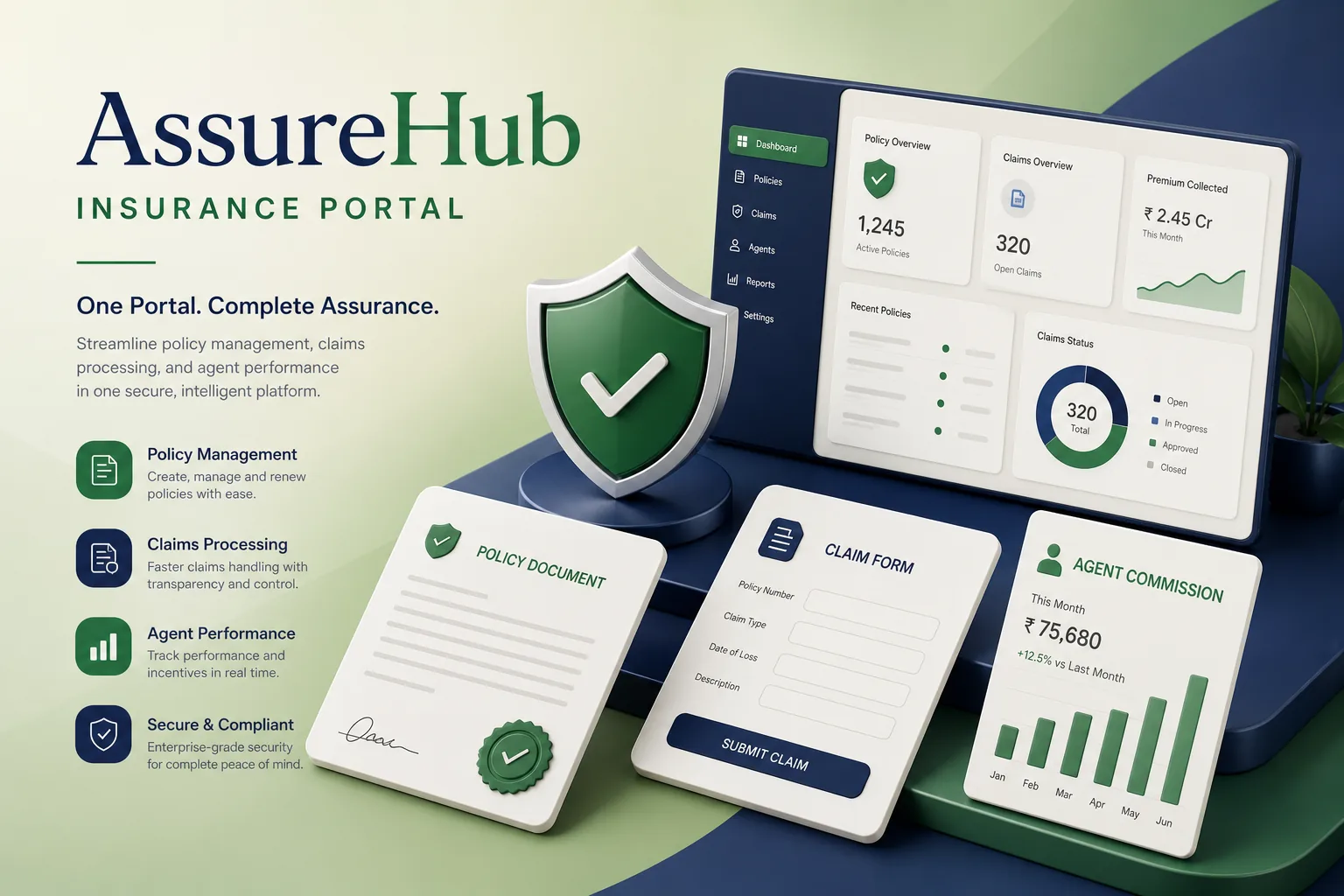
An insurance web portal that brings quoting and policy issuance, first notice of loss and claims handling, and agent commission statements into one audited system.
Project overview
We built a web portal for a general insurer selling motor, home and small-business cover through a network of independent agents. Agents quote and issue policies, policyholders report claims and download documents, claims handlers work a structured queue, and finance runs commission statements from the same data.
The project covered discovery, UX, an Angular front end, a .NET Core API, a SQL Server data model and a migration from the previous systems. It is part of our fintech app development practice and follows the controls described on our security and compliance page.
The client and the challenge
Policies were rated in spreadsheets, issued as documents emailed by underwriters, and stored in a legacy policy system that agents could not access. Claims arrived by phone and email with missing details, and commission was calculated monthly by hand, which led to frequent agent queries. Policyholders had no online access to their documents, so simple requests such as a replacement certificate or a claim status update landed in the same shared inbox as new business, and response times depended on who happened to be free.
The insurer wanted agents to issue standard policies themselves within underwriting rules, a guided claims intake, and transparent commission statements — with a full audit trail on every change to a policy, claim or payment.
Solution architecture & delivery
Product rules live in versioned rating tables in SQL Server rather than in code: base rates, rating factors, discounts, loadings and referral triggers per product. When an agent quotes, the .NET Core rating service evaluates the table version in force on the start date, so mid-year rate changes never alter policies already issued. Quotes that hit a referral rule, such as a high sum insured or prior claims, go to an underwriter queue with the reason attached.
Issuance creates the policy, schedule and certificate documents from templates, posts the premium to the billing ledger and records the commission due to the agent. Endorsements, renewals and cancellations are modelled as new policy versions with effective dates, so any past state of a policy can be reproduced for a dispute or audit. Renewal runs are scheduled jobs: each policy due for renewal is re-rated on the current table, referred if rules demand it, and otherwise offered to the agent and policyholder with the new premium and any changes explained.
Claims start with a guided first notice of loss form that asks different questions per cover type and collects photos and documents. Each claim moves through states — registered, assessed, reserved, approved, paid or declined — with role-based permissions deciding who can set reserves or approve payments above a limit. Personal data is masked for roles that do not need it, and every view and change is written to an append-only audit log.
The Angular application gives agents, policyholders and staff separate role-based workspaces over the same API. Commission statements are generated from issued and paid premiums, including clawbacks on cancellations, and agents can drill from a statement line to the underlying policy. Partners integrate through REST APIs, and we compare similar controls in our loan origination workstation case study.
Key features we built
- Versioned rating tables with effective dates and referral rules
- Agent quoting and self-service issuance within underwriting limits
- Policy documents generated from templates at issuance and endorsement
- Guided first notice of loss with cover-specific questions and uploads
- Claims workflow with reserves, approval limits and payment states
- Agent commission statements with clawbacks and drill-down
- Field-level masking of personal data by role and append-only audit log
- REST APIs for partner, billing and reporting integrations
How we delivered it
- Discovery. Workshops with underwriting, claims and finance to document products, rating factors, claim states and commission rules, including edge cases like mid-term cancellations.
- Design. Role-based UX for agents, policyholders and handlers, prototyped and reviewed with a group of agents before build.
- Build. Two-week sprints on rating, issuance, claims and commissions, with automated tests comparing new rating output against historical spreadsheet quotes.
- Migration. In-force policies and open claims migrated from the legacy system in rehearsed runs, reconciled against source totals before cut-over.
- Launch and support. Roll-out to agents in groups, followed by ongoing enhancements and product changes handled through configuration.
Technology choices
- Angular — a structured framework for large, form-heavy role-based workspaces with strong typing and reusable components.
- .NET Core — a mature back end for rating logic, document generation and transactional workflows with good testing tools.
- SQL Server — transactional consistency for policies, claims and ledgers, with temporal versioning well suited to audit needs.
Outcomes
- Agents issue standard policies themselves, with only referred risks reaching underwriters
- Rate changes are made in configuration without touching policies already in force
- Claims arrive complete through guided intake instead of scattered phone calls and emails
- Agents see their own commission statements and the policies behind each line
- Every change to a policy, claim or payment is traceable in one audit log
- One portal replaced spreadsheets, shared inboxes and a closed legacy system
FAQ
How does the portal handle rate changes without affecting existing policies?
Rating tables are versioned with effective dates. A quote or renewal uses the version in force on its start date, so existing policies keep the rates they were issued on.
How is sensitive policyholder data protected?
Access is role-based, personal fields are masked for roles that do not need them, data is encrypted in transit and at rest, and every view and change is logged. The insurer's own compliance team signed off the data retention rules. Claims payments above a handler's limit need a second approver, and bank detail changes on a claim trigger a verification step before any payment is released.
Can the portal integrate with existing billing or core systems?
Yes. We exposed REST APIs for billing, partners and reporting and migrated in-force data from the legacy system. Our legacy software modernization service covers this kind of transition.
How long does an insurance portal like this take and what does it cost?
Scope depends on the number of products, claim types and integrations. Try our app development cost calculator for an indicative range, or contact us for a scoped plan.
Insurance Policy, Claims and Agent Portal screens
Build your next fintech product with Next Olive
Share your requirements — we will propose scope, timeline and stack within one business day.