AI Resume Screening Platform
A resume screening platform that reads CVs against a job's requirements, explains each match in plain language and leaves every hiring decision with a recruiter.
Project overview
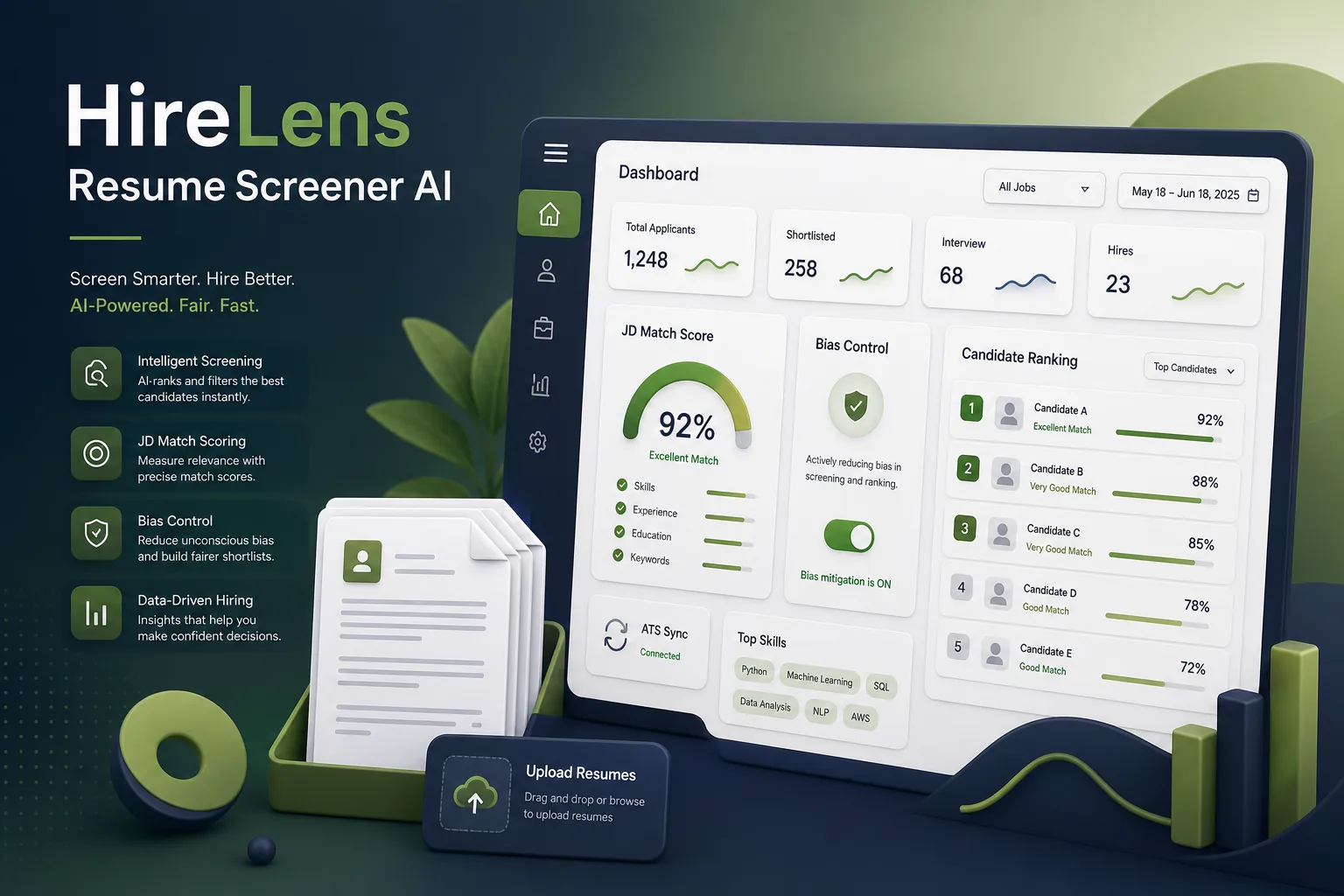
We built an AI resume screening platform for a recruitment agency that handles high application volumes for its clients. Recruiters paste or import a job description, the platform turns it into structured requirements, and every incoming CV is assessed against them with evidence quoted from the document.
The project covered requirement extraction, CV parsing, the matching service, bias and privacy controls and a recruiter-facing web app. It draws on our generative AI development practice and our experience building job portal platforms and HR and payroll software.
The client and the challenge
Recruiters were reading every CV by hand. Popular roles attracted far more applications than the team could review carefully, so strong candidates with unconventional CVs were missed and shortlists depended on who happened to read which pile. Keyword filters in the old applicant tracking system rejected people for using different job titles or phrasing. Hiring managers also asked why particular candidates had been put forward, and the answer was rarely written down.
The agency wanted help ranking applicants without handing decisions to a black box. Screening had to be explainable to hiring managers and candidates, avoid using protected characteristics, keep personal data under control and work with CVs in many layouts, including scanned PDFs.
Solution architecture & delivery
When a job is created, an LLM step through the OpenAI API converts the description into a structured requirement list: must-have skills, nice-to-have skills, experience ranges, certifications and location or work-right constraints. The recruiter edits and confirms this list before any CV is scored, so the criteria are always visible and agreed by a person. Requirements that could act as proxies for protected characteristics, such as graduation years or "native speaker" wording, are flagged for the recruiter to rephrase.
Incoming CVs are converted to text, split into sections and passed through a redaction step that removes names, photos, dates of birth, addresses and other details not needed for screening. The redacted CV and the confirmed requirements go to the model with a strict prompt that returns JSON: whether each requirement is met, partly met or not evidenced, plus the exact CV passage supporting it.
The FastAPI service validates that output, rejects answers without supporting quotes and turns requirement results into a transparent score that recruiters can re-weight. Candidates are never automatically rejected; low scores simply sort lower, and any recruiter can open the full original CV. Every assessment stores the prompt version, model version and requirement list for audit. Bulk imports are processed as background jobs, and recruiters see progress while a large applicant batch is assessed.
For bias control we built evaluation sets of paired CVs that differ only in attributes that should not matter, and run them whenever prompts or models change. Data retention rules delete CVs after a configurable period, and access is restricted by client and role, in line with our security and compliance practices.
Key features we built
- Job description to structured requirements, confirmed by the recruiter
- CV parsing for common document formats and scanned files
- Redaction of personal details before AI assessment
- Requirement-by-requirement match with quoted evidence from the CV
- Adjustable weighting and ranked shortlist view
- No automatic rejections; recruiters make every decision
- Audit log of prompts, model versions and criteria for each assessment
- Bias regression tests and configurable data retention
How we delivered it
- Discovery. Sessions with recruiters and the agency's compliance lead to agree screening criteria, what AI may and may not decide, and data retention rules.
- Evaluation set. A labelled set of past roles and anonymised CVs, reviewed by senior recruiters, used to compare prompt designs before building the product.
- Build. Two-week sprints delivering the parsing pipeline, FastAPI screening service and recruiter web app.
- Pilot. Recruiters used the ranked view alongside their normal process on selected roles, flagging disagreements that we used to refine prompts.
- Roll-out and support. Wider release across client accounts, with monitoring of model changes and bias tests under a support agreement.
Technology choices
- Python — strong libraries for document parsing, text cleaning and evaluation scripts, all in the same language as the API.
- FastAPI — typed request and response models that validate LLM output before it reaches recruiters, with async handling for bulk CV imports.
- OpenAI — reliable structured output for requirement extraction and evidence-based matching, called only with redacted CV text.
Outcomes
- Recruiters shortlist from one ranked view instead of reading every CV in arrival order
- Candidates with unconventional job titles are no longer filtered out by exact keywords
- Every score can be explained to a hiring manager using quotes from the CV
- Personal details are removed before AI assessment and deleted on schedule
- Prompt and model changes are checked against bias tests before release
- Screening criteria are agreed up front, making shortlists more consistent between recruiters
FAQ
Does the AI decide who gets rejected?
No. The platform ranks and explains; it never rejects a candidate. Recruiters see every application, can re-weight criteria and make all progression decisions themselves. The ranking is a starting point for their judgement, not a replacement for it.
How is bias handled in AI resume screening?
Personal details are redacted before assessment, the model only judges agreed job requirements, and paired-CV bias tests run whenever prompts or models change. Recruiters can also flag any assessment they disagree with for review.
Can it integrate with an applicant tracking system?
Yes. The FastAPI service accepts CVs and jobs through an API and returns structured results, so it can sit behind an existing ATS. Similar tool-calling patterns with human approval are covered in our article on AI agents with human approval. Results can also be written back to candidate records as notes.
How much does an AI screening tool cost to build and run?
Cost depends on integrations, document variety and monthly screening volume, which drives model usage. Our LLM and RAG cost calculator estimates running costs, and we quote the build after discovery.
AI Resume Screening Platform screens
Build your next ai model development product with Next Olive
Share your requirements — we will propose scope, timeline and stack within one business day.