AI Marketing Content and Image Studio
A web studio where a marketing team generates long-form blog drafts, ad copy variants and campaign images in its own brand voice, then edits and approves them before anything is published.
Project overview
We built a generative AI content studio for a marketing agency that produces blog articles, paid social ads and campaign visuals for many client brands at once. Writers and designers use it to create first drafts in each brand's voice, generate image options, and move everything through review before it goes to the client.
The project covered discovery with the agency's content leads, prompt and workflow design, the Next.js application, the text and image generation services, and an admin console for brand settings. It builds on our generative AI development work, where the goal is dependable drafts inside an existing editorial process, not unattended publishing.
The client and the challenge
The agency's writers were using general-purpose chat tools in separate browser tabs. Brand guidelines were pasted in by hand, outputs varied from person to person, nobody could see which drafts had been machine-generated, and images came from a different tool with no link to the copy they belonged to.
The client wanted one workspace per brand that remembered tone, vocabulary and banned claims; long-form drafts that followed a brief and an outline; many ad variants for testing; images that matched the campaign; and a clear approval trail showing who checked every piece.
Solution architecture & delivery
Each client brand has a profile holding its tone-of-voice notes, approved terminology, phrases to avoid, product facts and a set of example pieces the brand already likes. When a writer starts a job, the Next.js app assembles a structured brief from the form and the brand profile, so the prompt is built consistently rather than typed freehand.
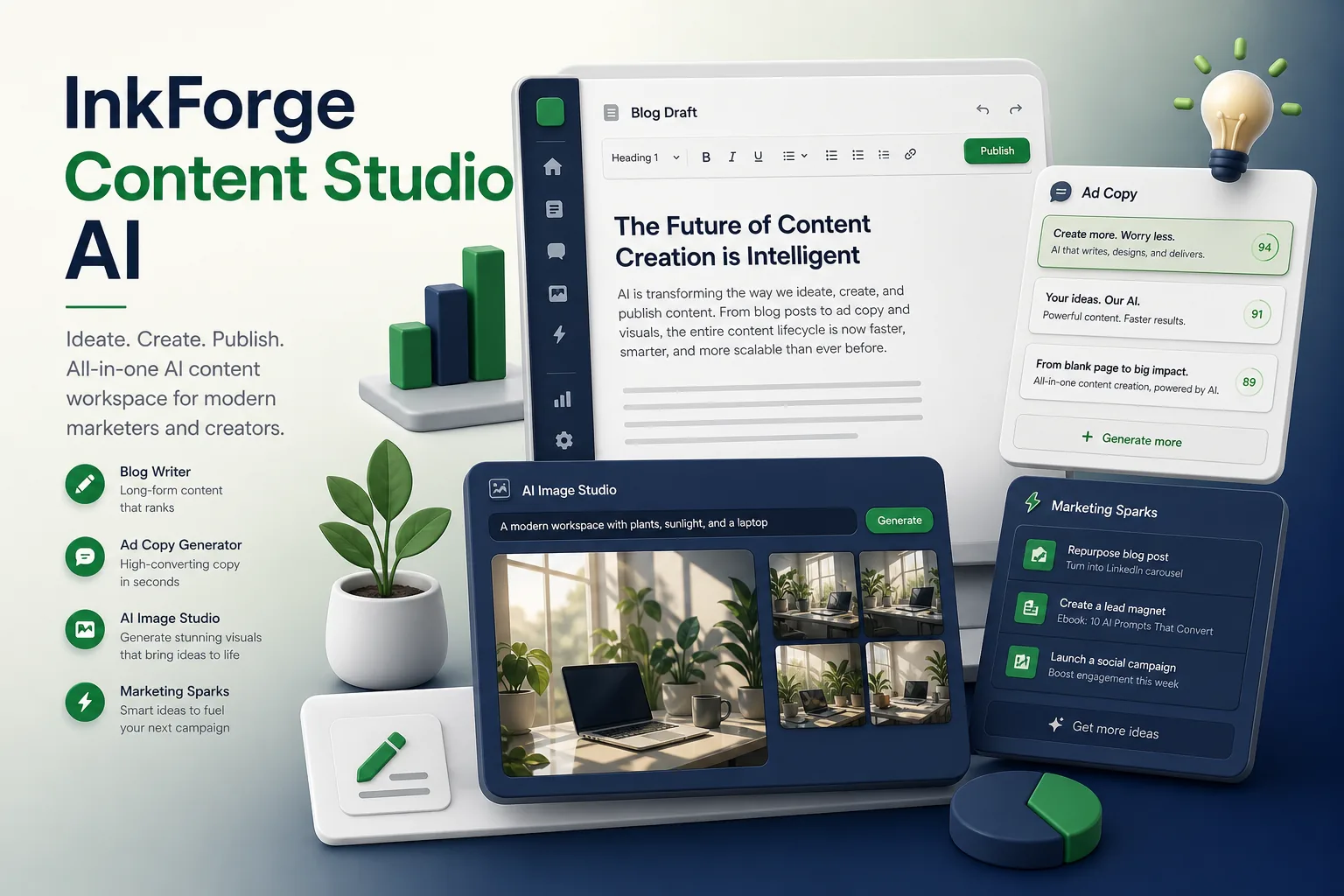
Long-form articles are generated in stages with OpenAI models: an outline first, which the writer edits and approves, then section-by-section drafting against that outline, then a checking pass that compares claims with the product facts and flags anything unsupported or on the banned list. Ad copy uses a separate template that returns headline and body variants within each ad platform's character limits, labelled by angle so the team can plan tests.
Images come from Stable Diffusion running on GPU instances in the agency's own cloud account, scaled down outside working hours when nobody is generating. Prompts are generated from the approved copy and the brand's visual style notes, and negative prompts plus a style reference keep results consistent. Designers pick candidates, request variations or inpaint regions, and every image stays linked to the campaign and copy it was made for.
Every asset moves through draft, in review, approved and exported states, with the generating prompt, model version and reviewer stored alongside it. Nothing is published automatically. For teams weighing similar tools, our comparison of ChatGPT and a custom AI agent explains why a brand-aware workflow like this beats ad-hoc chat use.
Key features we built
- Brand profiles with tone, terminology, banned claims and product facts
- Staged long-form drafting: outline, section drafts, fact-check pass
- Ad copy variants sized to each ad platform's character limits
- Stable Diffusion image generation with brand style references
- Image variations and inpainting for designer refinement
- Draft, review and approval workflow with full audit trail
- Rich-text editor with regenerate-this-section controls
- Export to documents and content management systems
How we delivered it
- Discovery. Workshops with writers, designers and account managers to map how briefs become published content and where brand errors usually crept in.
- Prompt prototyping. Side-by-side trials of prompt structures against real past briefs, scored by the agency's editors for voice, accuracy and usefulness.
- Build. Two-week sprints delivering the Next.js workspace, generation services, image pipeline and approval workflow in parallel.
- Pilot. A small group of brands onboarded first, with editors logging rejected drafts so prompts and brand profiles could be tightened.
- Roll-out and support. Onboarding of remaining brands, model version upgrades and new content templates under an ongoing support agreement, following our AI maintenance approach.
Technology choices
- Next.js — one framework for the editor interface, server-side generation routes that keep API keys off the browser, and streaming drafts into the page as they are written.
- OpenAI — language models for outlines, long-form sections, ad variants and the claim-checking pass, called with structured outputs so drafts slot into the editor cleanly.
- Stable Diffusion — self-hosted image generation with control over style references, negative prompts and inpainting, without sending campaign material to a third-party image service.
Outcomes
- Writers start from a structured, on-brand draft instead of a blank page or a generic chat reply
- Brand rules and product facts live in one profile and apply to every piece automatically
- Campaign images are generated alongside the copy they illustrate rather than in a separate tool
- Every asset shows how it was generated and who approved it
- Account managers can offer more ad variants for testing without adding writing capacity
FAQ
Does the studio publish AI-generated content automatically?
No. Every article, ad and image passes through a review and approval step, and the audit trail records who approved it. The system produces drafts; people decide what goes live.
How does it keep content on brand?
Each brand profile stores tone, terminology, banned phrases, product facts and example pieces. These are injected into every prompt, and a checking pass flags claims that are not backed by the stored facts.
Why self-host Stable Diffusion instead of using an image API?
Self-hosting gave the agency control over style references and inpainting, predictable running costs and no campaign material leaving their environment. A related project is our AI video editing software, which also runs generative media models.
How much does an AI content generation platform cost?
Cost depends on the number of content types, image generation needs, integrations and expected usage. Our AI agent cost calculator gives an indicative build and running range before a detailed quote.
AI Marketing Content and Image Studio screens
Build your next e-commerce & retail product with Next Olive
Share your requirements — we will propose scope, timeline and stack within one business day.