
AI Reorder Point and Safety Stock Planner
An inventory optimisation service that learns demand and supplier lead-time patterns, then recommends reorder points, safety stock and order quantities for every item at every warehouse and store.
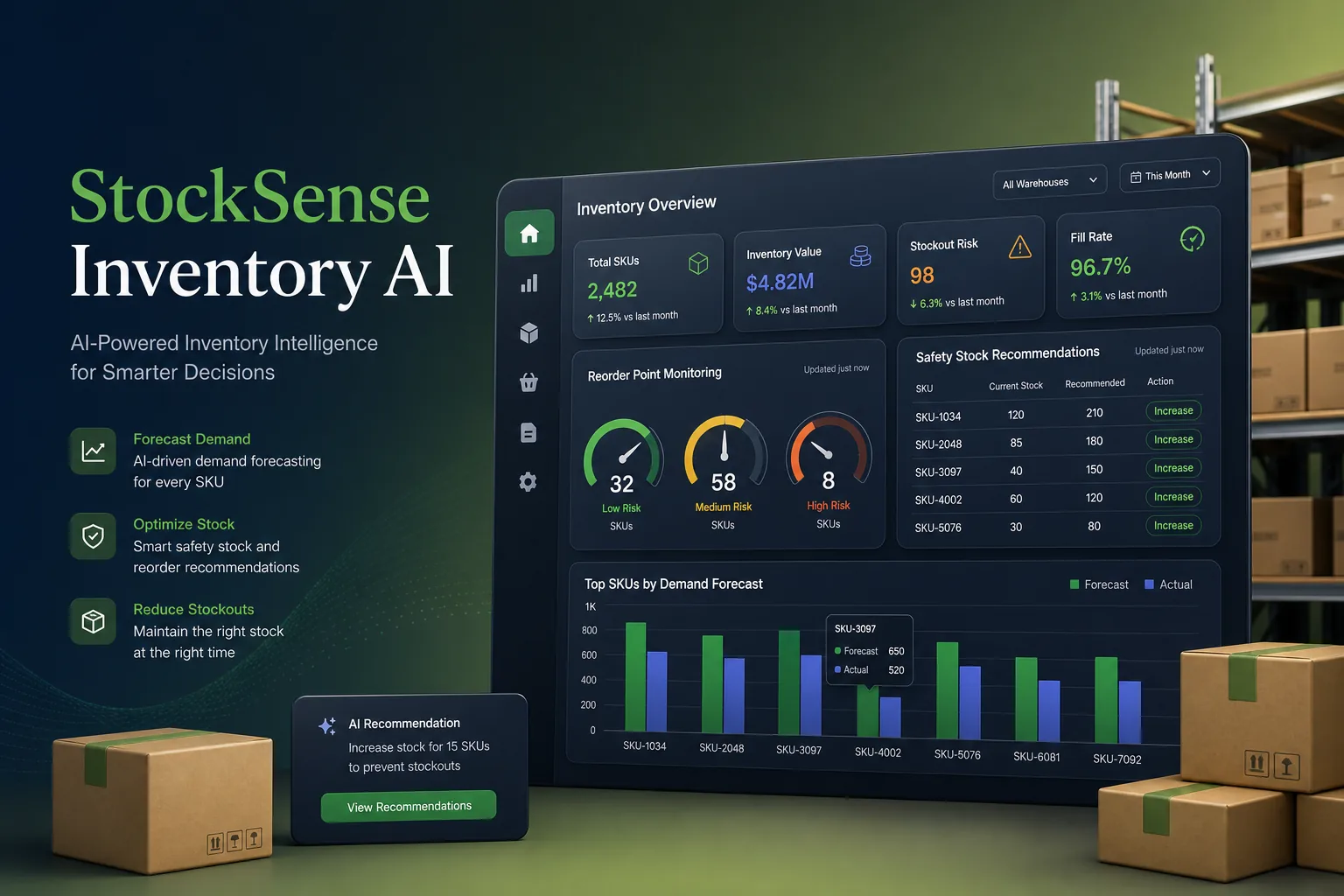
Project overview
We built an inventory planning service for a retailer that sells through stores and an online shop, supplied from regional warehouses. Every night it recalculates reorder points, safety stock levels and suggested order quantities for each item at each location, and buyers approve purchase orders from those recommendations.
The engagement covered data discovery, probabilistic demand and lead-time modelling in PyTorch, the optimisation logic, a FastAPI recommendation service, a buyer dashboard and integration with the client's inventory management system. It is part of our machine learning development services and our work for the e-commerce and retail sector.
The client and the challenge
Reorder points were static min/max values set when each item was first listed and rarely revisited. Seasonal items ran out at peak times, slow movers tied up warehouse space, and buyers compensated by placing emergency orders or ignoring the system and ordering from experience. Online orders and store sales drew on the same warehouse stock, but the old settings treated the channels separately, hiding the real demand on each location.
The client wanted stock levels that responded to changing demand and to suppliers whose delivery times varied, a service-level target that could differ by item importance, recommendations that respected minimum order quantities and pack sizes, and a clear reason behind every suggestion so buyers would trust it.
Solution architecture & delivery
Nightly data from the inventory system covers sales by channel, stock on hand, open purchase orders, receipts and supplier details. We rebuilt lead-time history from purchase order and receipt dates, which showed that several suppliers were far less predictable than their stated lead times suggested, so lead time is treated as a distribution rather than a fixed number.
Demand is modelled with a PyTorch sequence model that outputs a probability distribution for each item and location over the replenishment horizon, not just a single forecast. It shares learning across related items and locations, which helps slow movers with sparse history, and it takes promotions, seasonality and channel mix as inputs. Where a dedicated demand forecast already exists, as in our SKU-level demand forecasting project, it can be used as an input instead.
The optimisation step combines the demand distribution with the lead-time distribution by simulation to estimate demand during lead time. Safety stock and the reorder point are set to meet the service-level target for the item's class, with fast-moving essentials held to a higher target than long-tail lines. Suggested order quantities are then rounded to supplier pack sizes and minimums, and capped by warehouse capacity limits. Stock transfers between warehouses and stores are considered before a new purchase is suggested, so surplus in one location is used before buying more.
The FastAPI service exposes recommendations to the inventory system and to a buyer dashboard. For each suggestion, buyers see expected demand, lead-time variability, current cover and the reason the reorder point changed. They can accept, adjust or reject with a reason, and those decisions are logged to review the model's assumptions. Release and deployment followed our CI/CD and testing pipeline.
Key features we built
- Nightly reorder point and safety stock recalculation per item and location
- Probabilistic demand forecasts rather than single-point estimates
- Supplier lead-time variability learned from purchase order history
- Service-level targets by item class
- Order quantities rounded to pack sizes, minimums and capacity limits
- Buyer dashboard explaining why each recommendation changed
- Accept, adjust or reject workflow with reason codes
- Recommendation API integrated with the inventory management system
How we delivered it
- Discovery. Interviews with buyers and warehouse managers, and an audit of stock, sales and purchase order data to understand how replenishment really worked.
- Simulation study. Replaying past periods to compare static min/max rules with the proposed policy on stock-outs and inventory held, before building production services.
- Build. Two-week sprints for the modelling pipeline, optimisation logic, FastAPI service, dashboard and integration.
- Pilot. Recommendations enabled for a few product categories at one warehouse, with buyers reviewing every suggestion and flagging odd results.
- Roll-out and support. Extension to further categories and locations, scheduled retraining and monitoring of forecast calibration under a support agreement.
Technology choices
- Python — used for data preparation, lead-time analysis, simulation, optimisation logic and scheduling of nightly runs.
- PyTorch — lets us train a single probabilistic sequence model across many related items and locations, with custom loss functions for demand distributions.
- FastAPI — a lightweight, typed service for serving recommendations to the inventory system and dashboard, with clear request and response schemas.
Outcomes
- Reorder points update automatically as demand and supplier behaviour change
- Buyers approve purchase orders from explained recommendations instead of static min/max values
- Essential lines carry more protection against stock-outs than long-tail items
- Unreliable suppliers are visible through measured lead-time variability
- Order suggestions respect pack sizes and warehouse capacity without manual rework
FAQ
How is this different from demand forecasting?
Demand forecasting predicts sales. This service turns demand and lead-time uncertainty into concrete stock decisions: when to reorder, how much buffer to hold and how much to buy.
Can buyers override the recommendations?
Yes. Buyers can accept, adjust or reject any suggestion with a reason code. Overrides are logged and reviewed so recurring disagreements lead to model or rule changes.
Does it replace the existing inventory system?
No. It integrates with the client's inventory management system through an API and adds recommendations to their current purchasing workflow. Our desktop inventory manager case study covers a different, record-keeping side of stock control.
How much does an AI inventory optimisation system cost?
It depends on the number of items and locations, data quality and integration work. Our SaaS development cost calculator gives an indicative platform range, and we refine the estimate after a data audit.
AI Reorder Point and Safety Stock Planner screens
Build your next e-commerce & retail product with Next Olive
Share your requirements — we will propose scope, timeline and stack within one business day.