Telemedicine App with E-Prescriptions
A telemedicine platform where patients book and join video consultations, doctors issue e-prescriptions during the call, and prescriptions go straight to a partner pharmacy.
Project overview
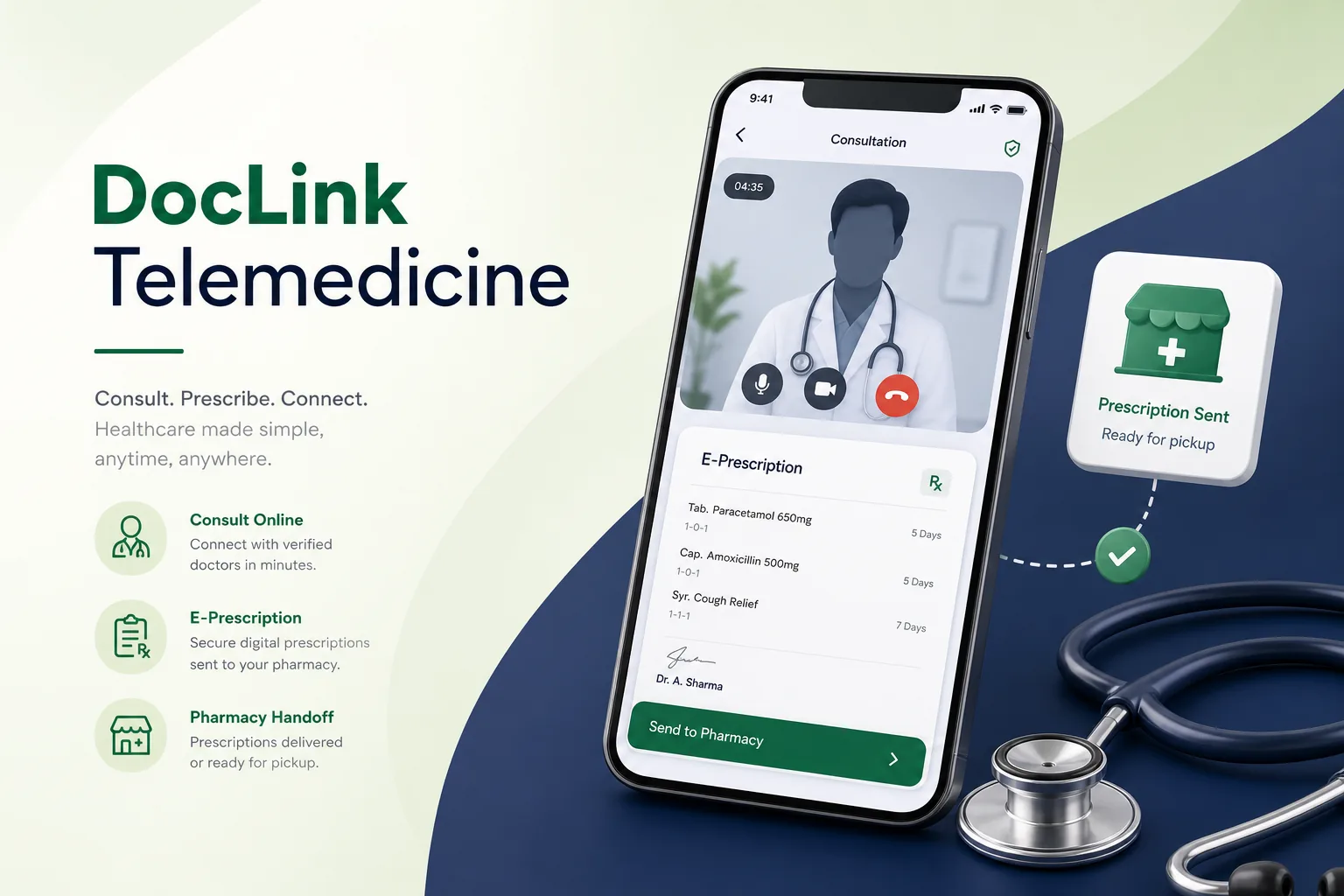
We built a telemedicine platform for a digital health provider working with a network of independent doctors and partner pharmacies. Patients choose a doctor, book a slot, pay, join a video consultation and receive a digital prescription they can send to a pharmacy for delivery or collection.
The engagement covered clinical workflow discovery, UX, React Native patient and doctor apps, a Node.js back end, WebRTC video, the prescription module and a lightweight pharmacy portal. It is part of our telemedicine app development work within the wider healthcare practice.
The client and the challenge
The provider had been running remote consultations over consumer video-calling apps and phone calls. Doctors wrote prescriptions on paper, photographed them and sent them over messaging apps, which pharmacies found hard to verify, and there was no structured record of what had been advised.
They needed consultations that worked on patchy mobile connections, prescriptions that pharmacies could trust, and a design that treated health data carefully: explicit consent before a consultation, access limited to the treating doctor, and no clinical content in notifications.
Solution architecture & delivery
The patient and doctor apps are built with React Native and share the booking, chat and call components. Doctors publish availability in the app; the Node.js scheduling service turns it into bookable slots, holds a slot while payment completes and sends reminders before the call.
Video runs on WebRTC. The Node.js signalling service only exchanges session descriptions between the two participants once both have joined the booked consultation; media flows peer to peer where the network allows and through a relay server when firewalls or mobile carriers block direct connections. The call adapts resolution to bandwidth and falls back to audio-only, and if it drops, both sides can rejoin the same consultation instead of starting a new booking.
During the call the doctor sees the patient's intake form, previous consultations and uploaded reports, and completes a structured prescription: medicine, strength, dosage, duration and advice. On submission the prescription is locked, stamped with the doctor's registration details and a unique verification code, and stored as a PDF and as structured data. The patient chooses a partner pharmacy; that pharmacy sees the prescription in its portal, can verify the code, and updates the order to packed, dispatched or ready for pickup.
Health records are encrypted at rest and in transit, every view of a patient file is written to an audit log, and consent is captured before each first consultation. Push notifications only say a message or document is waiting, never what it contains. Consult recordings are off by default, and doctors' consultation notes are visible to the patient only once the doctor marks them final. Doctors can only open records for patients who have booked with them; support staff see booking and payment details but not clinical notes, and any exceptional access requires a stated reason that is logged. Patients can download their own records or ask for their account to be closed from the app, and the admin console handles those requests against the provider's retention rules.
Key features we built
- Doctor search by speciality, language and next available slot
- Slot booking with payment hold and automated reminders
- WebRTC video consultations with audio-only fallback and rejoin
- Pre-consultation intake forms and report uploads
- Structured e-prescriptions with verification codes and PDF output
- Pharmacy handoff with order status tracking
- In-app follow-up chat within a set window after the consultation
- Admin console for doctor verification, payouts and audit logs
How we delivered it
- Discovery. Workshops with doctors, pharmacists and the provider's operations team to map booking, consultation, prescribing and dispensing, including what pharmacies needed to accept a digital prescription.
- UX and prototype. Prototypes of the booking and in-call prescribing screens tested with doctors, focusing on completing a prescription without leaving the video view.
- Build. Two-week sprints for the apps, API and pharmacy portal, with call quality tested on throttled networks and older handsets throughout, following our CI/CD and testing pipeline.
- Pilot. A limited launch with a small group of doctors and pharmacies to tune relay settings, reminder timing and the prescription format before opening to all patients.
- Support. Ongoing maintenance, OS and WebRTC library updates, and new specialities onboarded under a support agreement.
Technology choices
- React Native — shared booking, chat and call components across the patient and doctor apps on iOS and Android, with native modules for camera and audio handling.
- WebRTC — encrypted real-time video and audio inside the app, with adaptive bitrate and relay fallback for restrictive mobile networks.
- Node.js — signalling, scheduling and notification services that handle many short-lived real-time connections alongside the REST API.
Outcomes
- Consultations happen inside one app instead of consumer video-calling tools and phone calls
- Doctors prescribe in a structured form during the call rather than photographing handwritten notes
- Partner pharmacies can verify a prescription and fulfil it without chasing the doctor
- Patients keep their consultation history, prescriptions and reports in one place
- The provider has an audit trail of who accessed each patient record and when
FAQ
How does WebRTC video work on poor mobile networks?
The call adjusts resolution to available bandwidth, routes through a relay server when a direct connection is blocked, and drops to audio-only if video cannot be sustained. If the connection breaks, both participants can rejoin the same consultation.
How are e-prescriptions verified by pharmacies?
Each prescription is locked on submission and carries the doctor's registration details and a unique code. Pharmacies look the code up in their portal to confirm it is genuine and unaltered before dispensing.
Can the telemedicine app connect to clinic booking or hospital systems?
Yes. The scheduling and patient record services expose APIs, the same approach we used in a clinic appointment booking portal with online consultations.
How much does a telemedicine app like this cost to build?
It depends on the number of user roles, video requirements, prescription rules and pharmacy or lab integrations. Our app development cost calculator gives an indicative range and timeline before we scope a fixed quote.
Telemedicine App with E-Prescriptions screens
Build your next healthcare product with Next Olive
Share your requirements — we will propose scope, timeline and stack within one business day.