
Freight Marketplace with Instant Quotes
A freight marketplace where shippers post loads, get instant lane-based quotes from vetted carriers, and move from booking to signed electronic bill of lading in one place.
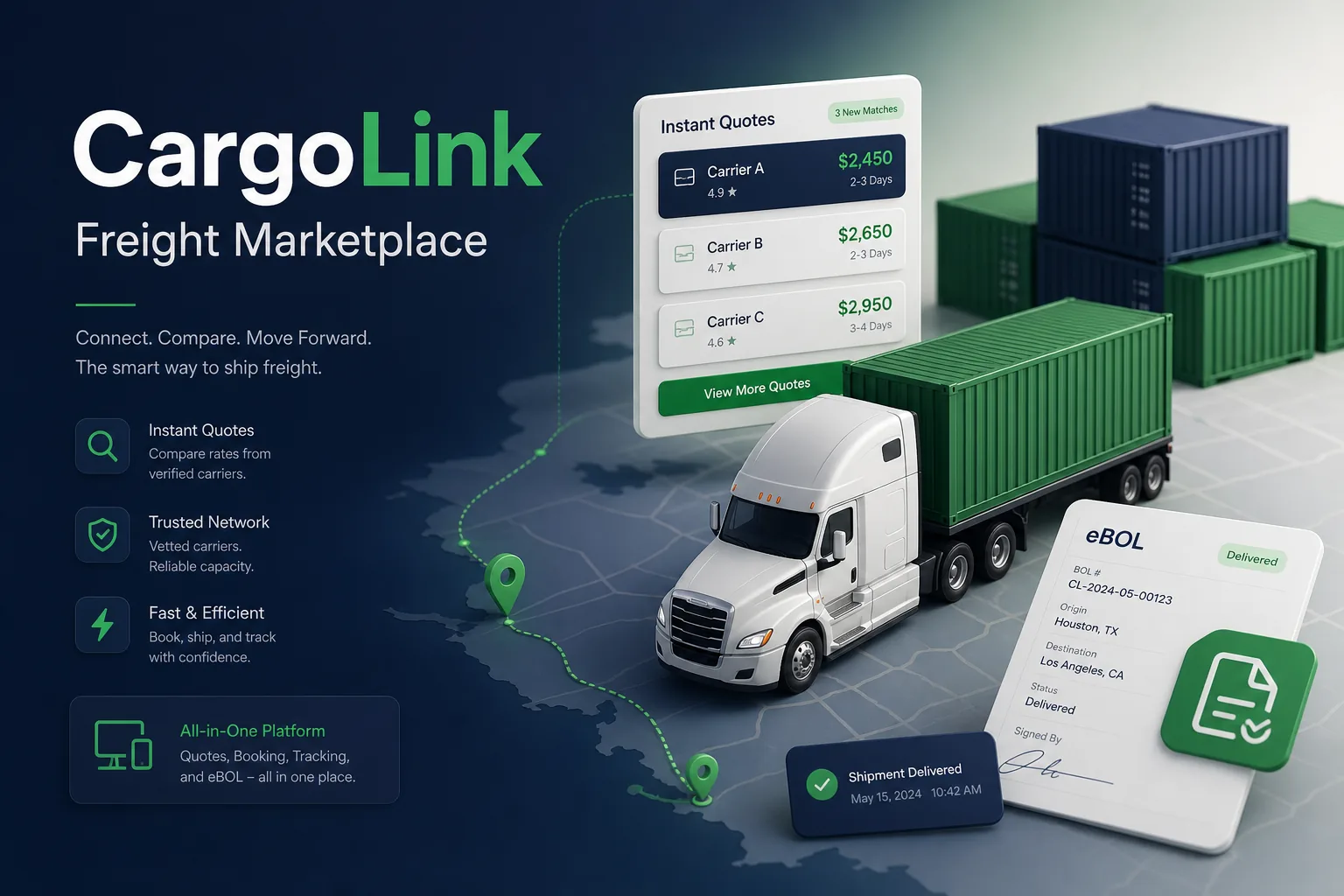
Project overview
We built a digital freight marketplace for a brokerage that had grown on phone calls, email and spreadsheets. Shippers post loads and receive instant quotes, carriers bid on or accept loads that match their equipment and lanes, and both sides sign an electronic bill of lading (eBOL) at pickup and delivery.
The engagement covered discovery with dispatchers, UX design, a Next.js front end, a Node.js API, a PostgreSQL data model for loads, lanes and rates, and a phased launch. It is part of our wider logistics software development work, and shares tracking ideas with our fleet management platform.
The client and the challenge
Dispatchers were quoting every load by hand from memory and old rate sheets, then phoning a short list of carriers until one said yes. Paper bills of lading came back late or illegible, which delayed invoicing and made proof-of-delivery disputes hard to settle. Carrier compliance documents sat in email attachments, so nobody could say with confidence whether a carrier's insurance was still valid on the day a load was handed over, and new carriers took days to onboard.
The client wanted self-service quoting for repeat shippers, a larger vetted carrier pool that could accept loads without a phone call, and a digital paper trail from tender to delivery — while keeping brokers in control of pricing and exceptions.
Solution architecture & delivery
The quoting engine prices a load from lane history stored in PostgreSQL: origin and destination regions, equipment type, weight band, lead time and accessorials such as liftgate or detention. Brokers set margin rules and floor rates per lane, so the shipper sees an instant, bookable price, while loads outside known lanes or with unusual requirements drop into a manual quote queue instead of guessing.
Once booked, a load is tendered to carriers whose equipment, service areas and compliance status match. Carriers are onboarded through a vetting workflow that captures operating authority, insurance certificates and bank details, with expiry dates tracked so a lapsed certificate automatically removes a carrier from tendering. Tenders go out in waves: preferred carriers first, then the wider pool, with a counter-offer option that brokers can accept or reject. Every tender, counter-offer and acceptance is timestamped against the load, so brokers can see exactly which carriers were offered a load, at what rate, and why it was awarded to the one that took it.
The eBOL is generated from the load record, so shipper, consignee, commodity and reference numbers are never retyped. Drivers open a secure link on a phone at pickup and delivery, capture signatures, photos and exceptions such as damaged pallets or short counts, and the signed document is stored against the load. A delivered, signed eBOL triggers carrier settlement and shipper invoicing in the finance workflow.
The Next.js web application renders public lane pages on the server and the authenticated dashboards as a fast client app. Status changes publish events that drive email and SMS notifications and feed a REST API that larger shippers use to push loads straight from their own systems.
Key features we built
- Instant lane-based quotes with broker-controlled margin rules
- Manual quote queue for unusual lanes, hazmat or oversized loads
- Carrier onboarding with authority, insurance and expiry tracking
- Wave tendering to preferred carriers, then the wider pool, with counter-offers
- Electronic bill of lading with mobile signature and photo capture
- Load status timeline with email and SMS notifications
- Settlement and invoicing triggered by signed proof of delivery
- REST API for shippers to post loads from their own systems
How we delivered it
- Discovery. Shadowing dispatchers and finance staff to map quoting, tendering, paperwork and settlement, and collecting historical lane data to seed pricing.
- UX and prototype. Prototypes of the shipper quote flow, carrier load board and driver eBOL screens, tested with a handful of friendly shippers and carriers.
- Build. Two-week sprints on the pricing engine, tendering and eBOL, with automated tests and staged releases following our CI/CD pipeline.
- Pilot. Launch with repeat shippers on established lanes while brokers reviewed every instant quote, then gradual loosening of the manual checks.
- Scale and support. Opening the carrier pool, adding shipper API integrations and ongoing maintenance under a support agreement.
Technology choices
- Next.js — server-rendered public pages for search visibility plus fast, authenticated dashboards for shippers, carriers and brokers.
- Node.js — an event-driven API well suited to many small status updates, notifications and tender responses.
- PostgreSQL — relational integrity for loads, rates and settlements, with strong querying over lane history for pricing.
Outcomes
- Repeat shippers book standard lanes from an instant quote instead of waiting for a call back
- Carriers accept matching loads from a board rather than being phoned one by one
- Signed eBOLs replaced paper bills of lading and removed retyping of shipment details
- Invoicing starts from proof of delivery, not from chasing paperwork
- Lapsed carrier insurance is caught automatically before a load is tendered
- Brokers spend their time on exceptions and unusual freight rather than routine quotes
FAQ
How are instant freight quotes calculated?
Quotes are built from historical lane data — origin and destination regions, equipment, weight and lead time — plus broker margin rules and floor rates. Loads outside known lanes are routed to a manual queue rather than auto-priced.
What is an electronic bill of lading and how does the driver sign it?
The eBOL is generated from the load record. At pickup and delivery the driver opens a secure link on a phone, captures signatures, photos and exceptions, and the signed copy is stored against the load for invoicing and disputes. If a driver has no signal at the dock, the capture screen keeps signatures and photos on the phone and uploads them once the connection returns, with the original capture time preserved.
Can shippers connect their own systems to the marketplace?
Yes. A REST API lets shippers post loads and receive status updates from their own ERP or transport tools. Our logistics and supply chain page covers other integrations we build.
How much does a freight marketplace like this cost to build?
It depends on pricing logic, carrier vetting, integrations and document workflows. Our SaaS development cost calculator gives an indicative range, or contact us for a scoped estimate.
Freight Marketplace with Instant Quotes screens
Build your next logistics & mobility product with Next Olive
Share your requirements — we will propose scope, timeline and stack within one business day.