Employee Self-Service HR Chatbot
An HR assistant in the company chat tool and intranet that answers policy questions with cited sources and completes self-service tasks such as leave balances and requests through the HR system.
Project overview
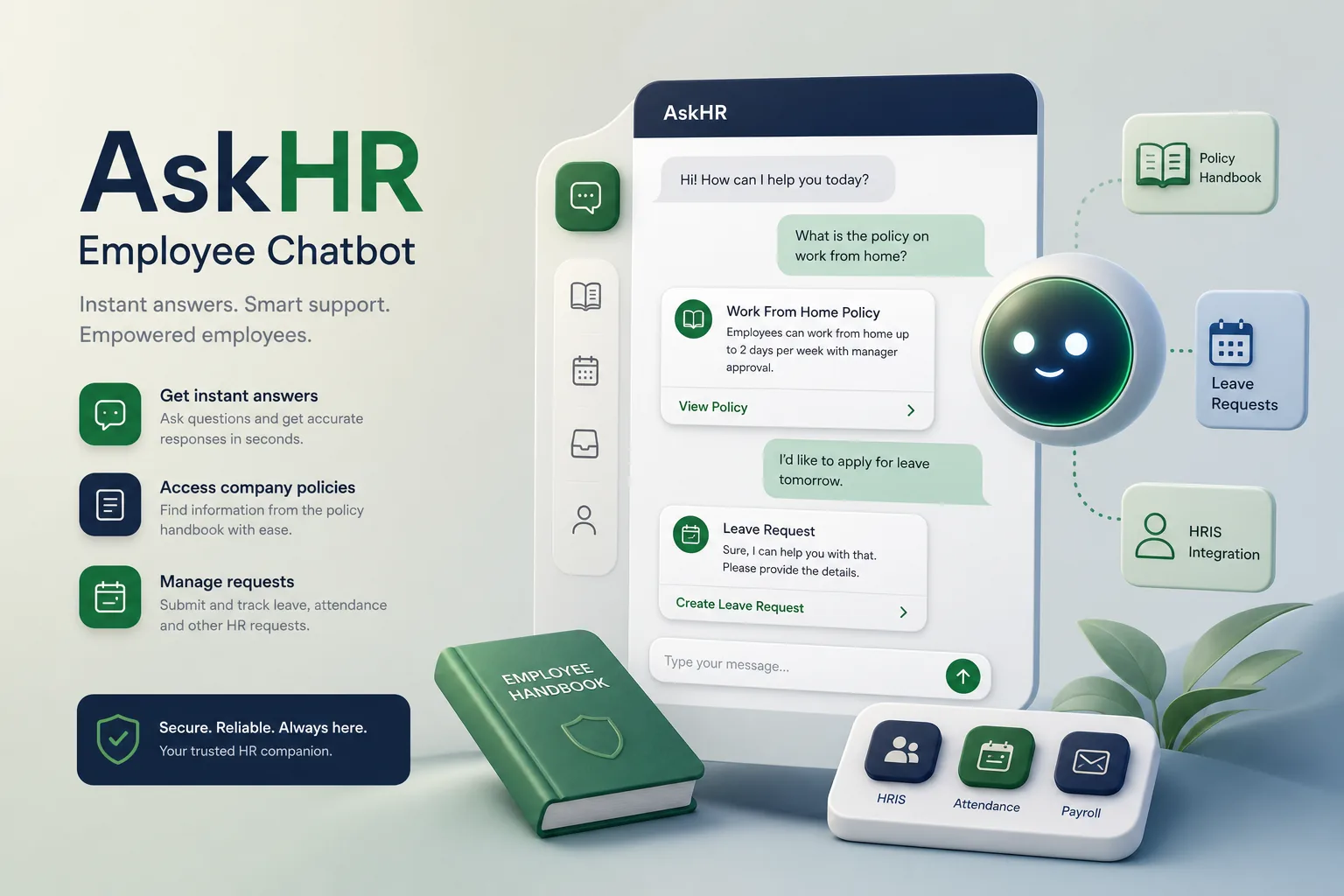
We built an employee self-service assistant for a company whose HR team was fielding a constant stream of routine questions from staff across several offices and remote teams. Employees ask in plain language through the workplace chat tool or the intranet, and the assistant answers from the company's own policies or performs simple actions in the HR information system (HRIS).
Our scope covered discovery with HR, document preparation, retrieval design, the Python and LangChain assistant, HRIS integration, an admin console and a staged launch. It is part of our AI chatbot development services, where assistants have to be accurate, permission-aware and honest about what they do not know.
The client and the challenge
HR business partners spent much of their day answering the same questions: how many leave days remain, how parental leave works, when expenses are reimbursed, where a form lives. Policies were spread across PDFs, intranet pages and old emails, sometimes with conflicting versions, and answers varied depending on who responded.
The client wanted instant answers grounded in current policy, differences by location and employee grade handled correctly, personal data such as salary shown only to the right person, and sensitive topics like grievances or wellbeing routed to a human rather than handled by a bot. Employee representatives also asked for clear information on what the assistant logged and who could read conversations.
Solution architecture & delivery
We started with the content. Policies were collected, duplicates and outdated versions retired, and each document tagged with its applicable locations, employee groups and effective dates. Documents are split into sections that respect headings, embedded and stored in a vector index in the client's own cloud tenancy, following our production RAG architecture.
When an employee asks a question, the LangChain pipeline identifies them through single sign-on and looks up their location and grade from the HRIS. Retrieval is filtered by those attributes, so a question about notice periods only sees the policy that applies to that person. An Azure OpenAI model then writes an answer using only the retrieved sections and cites the source document; if nothing relevant is found, it says so and offers to raise a ticket with HR. Every answer shows the policy name and effective date, so employees can open the full document if they want the detail.
For personal tasks, the assistant uses a small set of tools that call the HRIS API with the employee's own identity: check leave balance, submit a leave request, download a payslip, and update contact details. Any action that changes data shows a confirmation card before it is submitted, and the assistant cannot see or act on anyone else's records.
A classifier screens each message for sensitive topics such as harassment, health or resignation. Those conversations are not answered by the model; the employee is shown confidential contact options and, with their consent, a case is opened for an HR partner. Conversation logs are retained for a limited period, personal data is masked in analytics, and the HR admin console shows unanswered questions so the team can fill policy gaps.
Key features we built
- Policy answers with citations to the source document
- Location and grade-aware retrieval filtering
- Leave balance, leave requests and payslip download via the HRIS
- Confirmation step before any data-changing action
- Single sign-on identity with no access to other employees' data
- Sensitive-topic detection with confidential handover to HR
- Available in the workplace chat tool and the intranet
- Admin console for documents, unanswered questions and feedback
How we delivered it
- Discovery. Analysis of HR ticket history to find the most frequent question types, plus workshops on data access, sensitive topics and employee consultation requirements.
- Content clean-up. Working with HR to consolidate policy versions, tag applicability and write short answers for gaps the documents did not cover.
- Build. Two-week sprints for retrieval, HRIS tools, chat integrations and the admin console, with a growing test set of real questions and expected answers.
- Pilot. Launch to one department, with HR reviewing a sample of conversations each week and marking answers correct, incomplete or wrong.
- Roll-out and support. Company-wide launch, policy re-indexing when documents change and ongoing evaluation under a support agreement, using practices from our AI agent testing and evaluation guide.
Technology choices
- Python — hosts the assistant service, document ingestion, HRIS tool functions, sensitive-topic classifier and evaluation scripts.
- LangChain — orchestrates retrieval with metadata filters, tool calling for HRIS actions and conversation memory within a session.
- Azure OpenAI — language models and embeddings deployed in the client's own cloud tenancy, so employee questions and HR documents stay within their existing data agreements.
Outcomes
- Employees get policy answers at any hour, with a link to the exact source
- HR partners spend less time on routine questions and more on complex cases
- Leave requests and payslip downloads happen in chat without opening the HR system
- Answers are consistent across locations because retrieval follows each employee's applicable policy
- Unanswered questions reveal gaps and conflicts in the policy library
FAQ
Can the chatbot see other employees' salaries or records?
No. Every HRIS call is made with the signed-in employee's identity and permissions, so the assistant can only retrieve or change that person's own data.
What happens with sensitive HR questions?
Messages about topics such as harassment, health or resignation are detected and not answered by the model. The employee is shown confidential contact options and can choose to open a case with an HR partner.
Have you built similar HR software?
Yes. Our HRMS and payroll platform covers the core HR records side, and our AI resume screening platform applies AI to recruitment.
How much does an HR chatbot like this cost?
It depends on the number of policy documents, HRIS integrations, chat channels and languages. Our AI agent cost calculator gives an indicative build and running range before a detailed proposal.
Employee Self-Service HR Chatbot screens
Build your next ai model development product with Next Olive
Share your requirements — we will propose scope, timeline and stack within one business day.