
Adaptive AI Tutor with Socratic Hints
An AI tutor for school students that asks guiding questions instead of giving answers away, adapts to each learner and keeps teachers and parents in the loop.
Project overview
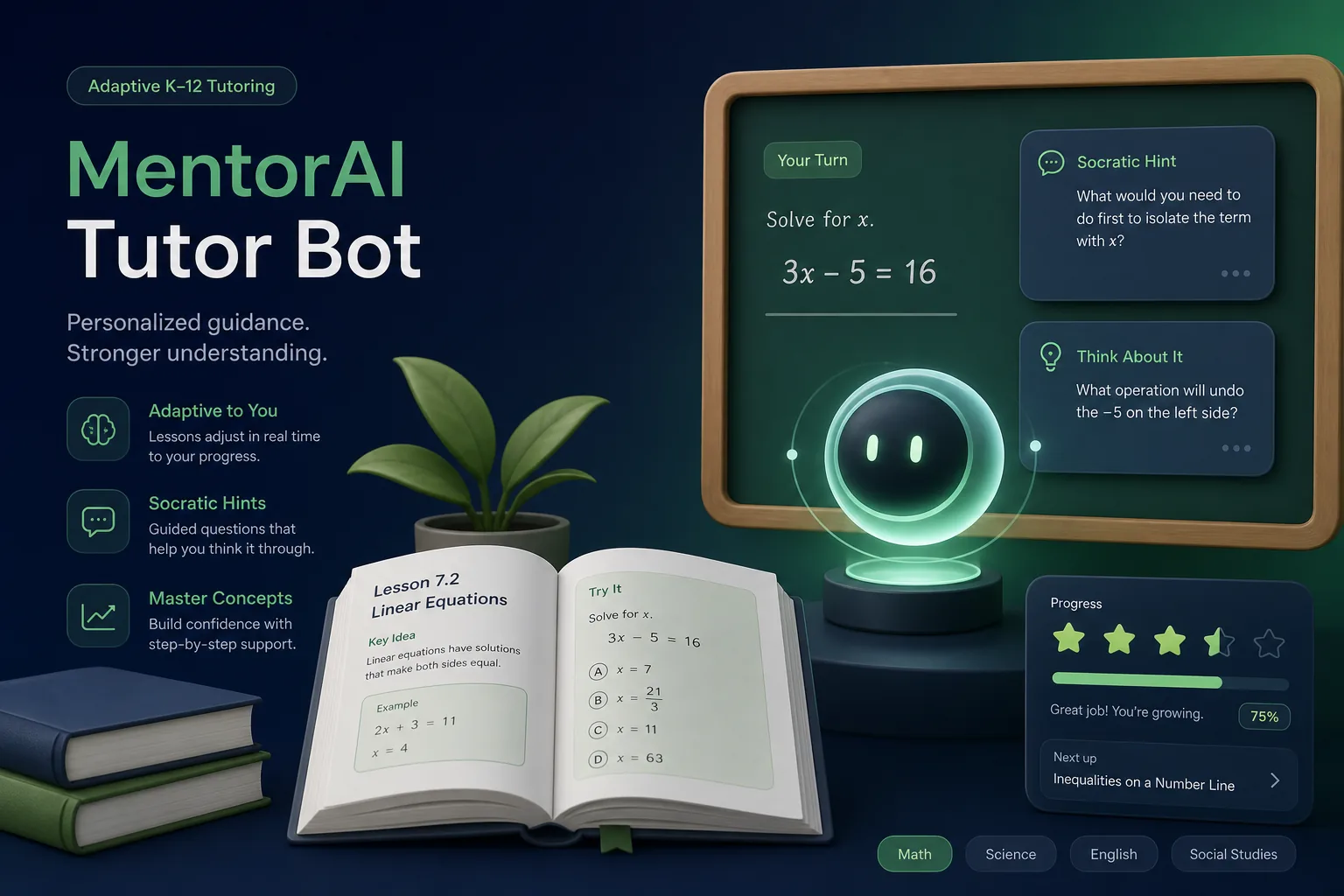
We built an adaptive AI tutor for a K-12 education provider. Students work through practice questions and can ask the tutor for help at any point; instead of revealing the answer, it asks guiding questions, gives graded hints and checks understanding before moving on.
The project covered curriculum ingestion, the tutoring engine, safety controls, the student app and a teacher dashboard. It combines our education app development work with generative AI development, and fits within our broader education technology portfolio.
The client and the challenge
Students practised at home without help when they got stuck. Parents could not always support every subject, and general chatbots simply produced full answers, which teachers saw copied into homework without any learning taking place.
The provider wanted a tutor that followed its own curriculum and teaching style, suited different ages, never showed inappropriate content and gave teachers visibility into where students struggled. Because the users were children, data minimisation and parental consent had to be designed in from the start. Teachers were also wary of any tool that would do the thinking for students or mark work without their oversight.
Solution architecture & delivery
Curriculum material, worked examples and marking guidance were split into chunks, tagged by grade, subject and topic, and indexed for retrieval. When a student asks for help, a LangChain pipeline retrieves the relevant lesson content and the student's current question, so GPT-4 responds from the provider's material rather than general knowledge, following the patterns in our article on production RAG architecture. If retrieval finds nothing relevant, the tutor says the topic is outside the lesson material instead of improvising.
The tutoring behaviour is a controlled sequence rather than open chat. The system first diagnoses the student's attempt, then offers a hint at the lowest useful level, such as a question about the first step, and only escalates to more specific hints if the student is still stuck. A separate check reviews each reply before it is shown and blocks any response that gives away the final answer too early. Students can type working, and for maths they can photograph handwritten steps, which are converted to text so the tutor can point at the exact line where the reasoning went wrong.
A learner profile records which topics a student has mastered and where hints were needed. The next practice question is chosen from that profile, so a student who struggles with fractions sees more scaffolded fraction problems before moving on. Language complexity is adjusted to grade level. Mastery estimates are updated after every attempt, and topics not practised for a while are brought back for short review.
Input and output moderation filters off-topic and unsafe content and redirects the conversation to the lesson. Student accounts are created by schools with parental consent, conversations store no unnecessary personal data, and teachers can review transcripts and flagged exchanges from their dashboard. Teachers can switch the tutor off for particular assignments, such as assessed homework, so it is only available where the school wants it.
Key features we built
- Socratic hints that escalate gradually instead of revealing answers
- Answers grounded in the provider's own curriculum content
- Adaptive practice questions based on each learner's mastery profile
- Grade-appropriate language and explanations
- Answer-leak check on every tutor reply before display
- Moderation of unsafe and off-topic messages
- Teacher dashboard with topic struggles and flagged conversations
- School-managed accounts with parental consent and minimal data
How we delivered it
- Discovery. Workshops with teachers and curriculum leads to define hint levels, tone for each age group and what the tutor must never do.
- Content preparation. Curriculum documents cleaned, chunked and tagged by grade and topic, with teachers reviewing sample retrieval results. Worked examples were checked for accuracy before indexing.
- Build. Two-week sprints delivering the tutoring pipeline, safety checks, student app and teacher dashboard, similar in structure to our online learning platform.
- Classroom pilot. Selected classes used the tutor with teachers reviewing conversations and rating hints, which shaped prompt and escalation rules.
- Roll-out and support. Additional grades and subjects added in stages, with evaluation sets re-run whenever prompts or models changed.
Technology choices
- Python — used for content ingestion, evaluation scripts and the tutoring API in one maintainable codebase.
- LangChain — orchestrates retrieval, the multi-step hint sequence and the safety checks as composable steps.
- GPT-4 — strong reasoning for diagnosing student mistakes and writing clear, age-appropriate guiding questions.
Outcomes
- Students get guided help when stuck at home instead of copying full answers
- Tutor explanations follow the provider's curriculum and teaching approach
- Practice adapts to each learner's weak topics
- Teachers can see which topics a class is struggling with before the next lesson
- Unsafe or off-topic conversations are filtered and surfaced for review
- New subjects are added by ingesting curriculum content rather than rebuilding the product
FAQ
How does a Socratic AI tutor avoid giving away answers?
Hints follow a fixed escalation from general to specific, and every reply is checked before display. If a reply would reveal the final answer too early, it is regenerated as a guiding question. Teachers can adjust how many hint levels each subject uses.
Is an AI tutor safe for children?
We designed for it: moderation on inputs and outputs, school-created accounts with parental consent, minimal personal data and teacher access to conversations. The tutor stays on curriculum topics and redirects anything else.
Can the tutor use our own curriculum and question bank?
Yes. The tutor retrieves from the institution's own material, which is how it matches local syllabi and terminology. We follow a similar approach in AI agents for schools.
What does an AI tutor cost to build and run?
Build effort depends on subjects, grades and integrations, while running cost depends on usage. Our LLM and RAG cost calculator estimates model costs, and we quote the build after discovery.
Adaptive AI Tutor with Socratic Hints screens
Build your next education product with Next Olive
Share your requirements — we will propose scope, timeline and stack within one business day.